
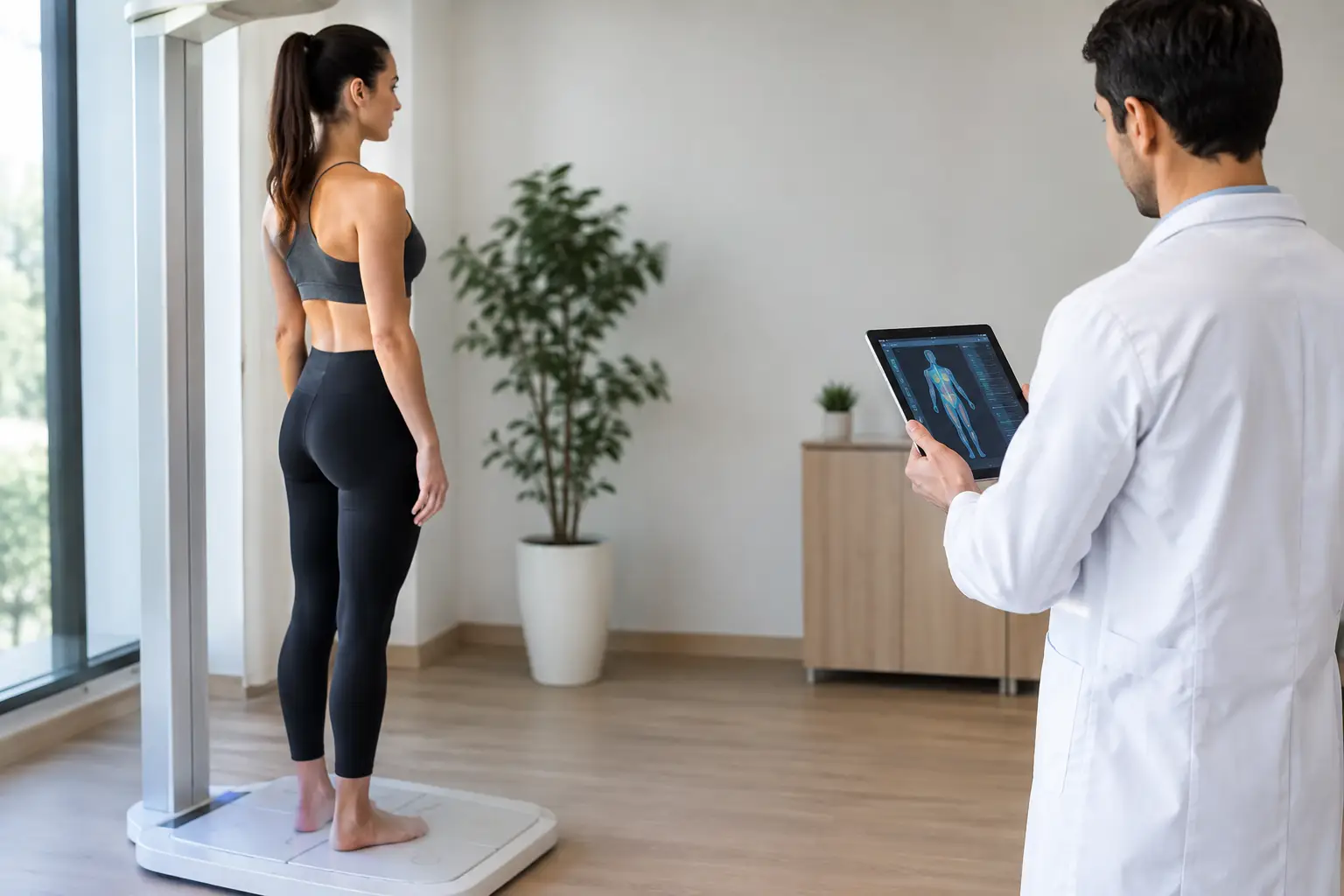
Your weight tells you how much you weigh. Your body composition tells you what you are made of. For anyone serious about performance, health, or aging well, knowing the difference is essential. Body composition scanning moves you beyond the scale into territory where real change becomes visible and measurable. This guide covers what you actually need to know about getting scanned, interpreting the data, and using it to inform decisions about training, nutrition, and recovery.
The market for body composition measurement has expanded dramatically over the past decade. Advanced scanning technology now gives precision feedback that was previously available only in specialized labs. Understanding which methods matter, what they measure, and how to act on the results is what separates useful data from noise.
Why Weight Alone Is Not Enough
Two people can weigh exactly the same and have completely different body compositions. One may be 30% body fat with limited strength and mobility. The other may be 15% body fat with solid muscle mass and functional capacity. Both weigh 180 pounds. The scale cannot tell the difference.
Body mass index fails to differentiate fat mass from lean mass and systematically misclassifies adiposity risk, a limitation particularly pronounced in populations that exhibit elevated visceral adiposity at a normal BMI. For many people, fat mass and lean mass can be moving in opposite directions simultaneously. During training, you might lose fat while gaining muscle, yet the scale stays the same. Without body composition data, you would incorrectly conclude nothing is happening.
The Gold Standard: DEXA Scanning
DEXA (dual-energy X-ray absorptiometry) remains the clinical gold standard for body composition measurement. DEXA is more accurate than other measurement methods and can identify important factors that aren't visible from the outside, like visceral fat and bone mineral density.
A DEXA scan measures three key compartments: fat mass (including visceral fat), lean mass (muscle and organs), and bone mineral density. The scan takes about 10-20 minutes, exposes you to minimal radiation (less than a day of natural background radiation), and produces a detailed breakdown of your body. You get total body measurements plus regional breakdowns by arm, leg, and trunk.
The limitation of DEXA is availability and cost. Not every clinic has access, and a scan can run $200-400. DEXA also cannot be done frequently without radiation concerns, so once or twice yearly is the practical maximum.
3D Body Scanning: Precision Without Radiation
3D optical scanners create a detailed three-dimensional model of your body in seconds, capturing hundreds of automated measurements. The technology calculates body volume, surface area, limb circumferences, and proportions with remarkable precision. When combined with algorithms trained on DEXA data, 3D scanners can estimate fat mass, lean mass, and visceral fat with accuracy very close to DEXA itself.
The advantages are significant. There is zero radiation exposure, no cost barrier (often $75-200 per scan), scans take seconds, and you can be scanned frequently without health concerns. This makes 3D scanning ideal for tracking progress every 4-12 weeks as you train and adjust nutrition.
What Body Composition Data Actually Tells You
Fat Mass and Fat Percentage
Total body fat is one metric. More useful is understanding where that fat is stored. Subcutaneous fat (under the skin) is metabolically less risky than visceral fat (around organs). Higher visceral adiposity is linked to higher rates of hypertension and atherogenic dyslipidemia, with visceral fat tracking with metabolic disease phenotypes.
For healthy adults, reasonable body fat targets vary by age and individual goal, but generally 15-25% for men and 20-30% for women represent good health. Below those ranges may indicate over-restriction. Above those ranges often correlates with metabolic disease risk.
Lean Mass and Muscle
Lean mass includes muscle, bone, organs, and water. For most people, the goal is to preserve or build muscle while losing fat. Progressive strength training combined with adequate protein supports this outcome. A body composition scan shows whether your training and nutrition are actually building muscle or just burning calories.
Bone Mineral Density
Bone health is often overlooked until it becomes a problem. DEXA scans include bone mineral density measurement, which identifies osteopenia or osteoporosis early. Strength training and adequate protein intake are powerful bone-building interventions.
How to Use Scanning Data Intelligently
A single scan is a snapshot. A series of scans over months and years is a trend. The most useful body composition approach involves baseline testing, then repeat measurements every 8-16 weeks to track changes in response to your training and nutrition decisions.
When fat mass is decreasing and lean mass is stable or increasing, your approach is working. When lean mass is dropping along with fat, you need more protein and possibly less aggressive calorie deficit or higher volume resistance training. When both are stable despite effort, the limiting factor may be sleep, stress, recovery capacity, or metabolic health rather than exercise alone.
Visceral fat trends matter more than total fat percentage alone. As visceral fat decreases, metabolic health usually improves faster than subcutaneous fat changes would suggest. This is why the data matters—it reveals what visible changes in appearance might not.
Combining Body Composition Data With Other Markers
Body composition scanning is most useful when paired with other data. Strength progression, training volume, wearable recovery metrics, metabolic testing, and blood work all provide context. Someone who loses fat while maintaining muscle and strength is tracking correctly. Someone who loses fat but also loses strength has lost more than desired.
The goal is not a number on a scan. It is building a body that performs, feels strong, recovers well, and ages resilently. Scanning data is simply the tool that makes the invisible visible—allowing you to confirm that your training, nutrition, and recovery are actually producing the changes you intend.
Ready to See Your Body Composition?
A 3D body scan gives you precise measurements of fat mass, lean mass, visceral fat, and body proportions in seconds—with zero radiation. Get a baseline scan and start tracking meaningful progress.
Book Your Body Scan