
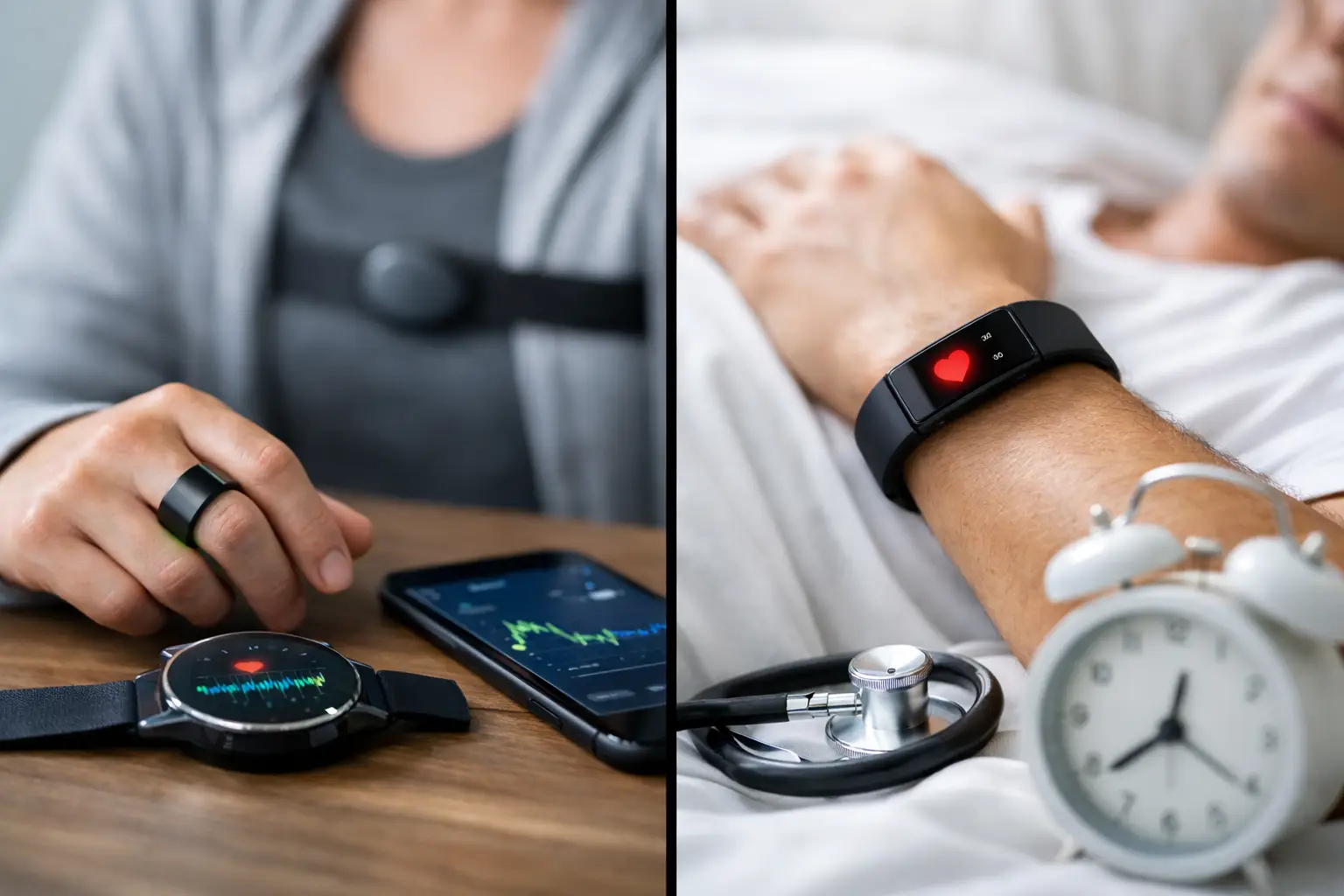
Your wearable shows a lower HRV than usual, but your resting heart rate is unchanged. Should you cancel your workout, go harder, or ignore the data? The answer is rarely found in one number. HRV tracking vs resting heart rate is not a competition between two recovery metrics. It is a question of what each signal can reveal about your nervous system, cardiovascular load, sleep, stress, and readiness to perform.
For active adults, busy professionals, and anyone investing in long-term health, the goal is not to chase a perfect score. It is to recognize meaningful patterns early enough to adjust training, recovery, nutrition, and clinical care before fatigue becomes a plateau, injury, or burnout.
HRV Tracking vs Resting Heart Rate: The Core Difference
Resting heart rate, or RHR, is the number of times your heart beats per minute while you are at rest. Most wearables capture it during sleep or early morning, when movement and outside demands are low. A lower resting heart rate can reflect improved cardiovascular fitness, but context matters. It can also be influenced by genetics, medication, illness, dehydration, overreaching, alcohol, poor sleep, and chronic stress.
Heart rate variability, or HRV, measures the variation in time between consecutive heartbeats. It does not measure how fast your heart beats. Instead, it offers a window into how your autonomic nervous system is responding to demand. In simple terms, HRV reflects the balance and flexibility between your stress response and recovery response.
Higher HRV is often associated with greater recovery capacity and parasympathetic activity, commonly called the "rest and digest" state. Lower HRV may indicate that your body is carrying more stress. But higher is not always better, and lower is not automatically a problem. The most useful comparison is not your number against someone else's. It is your number against your established baseline.
Think of resting heart rate as a broad read on cardiovascular strain. Think of HRV as a more sensitive read on nervous-system load and adaptability. Together, they provide a stronger signal than either metric alone.
What Resting Heart Rate Can Tell You
Resting heart rate is practical because it is easy to understand and generally stable when your routines are stable. If your normal sleep-based resting heart rate is 55 beats per minute and it rises to 62 for several days, your system may be working harder than usual. That can happen after a demanding training block, a short night of sleep, a late meal, travel, dehydration, or the early stages of an illness.
For endurance athletes and highly active individuals, a gradually declining RHR over months may reflect improving aerobic efficiency. The heart can move blood with fewer beats at rest. However, a very low RHR is not automatically a performance badge. If it comes with fatigue, dizziness, poor exercise tolerance, disrupted sleep, or other symptoms, it deserves clinical attention.
RHR can be slower to change than HRV. This is useful when you want a stable trend, but it means it may not always flag accumulating stress at the earliest stage. A hard workout can affect HRV overnight while resting heart rate remains close to normal. That does not make RHR less valuable. It simply means it answers a different question.
What HRV Tracking Can Tell You
HRV tends to respond quickly to changes in recovery. A late night, alcohol, emotional stress, a high-intensity workout, pain flare-up, poor fueling, or fragmented sleep can all shift it. For many people, HRV acts like an early-warning system for stress that has not yet become obvious in energy levels or resting heart rate.
This sensitivity is exactly why HRV can be helpful and frustrating. It is not a scorecard for toughness or health. It is a dynamic biological signal. A single low reading after a difficult workday may be completely normal. What matters is a sustained downward shift from your usual range, especially when it appears alongside worsening sleep, lower motivation, higher soreness, persistent pain, or declining exercise performance.
HRV is also highly individual. One healthy person may average 25 milliseconds while another averages 75. Neither number is meaningful without context, measurement consistency, and a personal baseline. Comparing your HRV to a friend's, an online chart, or a professional athlete's data creates noise rather than insight.
When the Signals Agree, Pay Attention
The clearest recovery warning often occurs when HRV trends down while resting heart rate trends up. This combination can suggest that your body is under greater physiological load than it can currently absorb. It does not diagnose a condition, but it is a strong prompt to look at the full picture.
Ask what changed in the previous 24 to 72 hours. Was training volume higher? Did sleep quality fall? Are you managing a high-pressure deadline, travel, pain, a calorie deficit, or more alcohol than usual? Is a cold coming on? The root cause is often not one dramatic event but a stack of smaller stressors.
In this situation, replacing another all-out session with lower-intensity movement, mobility work, breathwork, hydration, adequate protein and carbohydrates, and an earlier bedtime can be a strategic move. Recovery is not lost training time. It is the process that allows training to create adaptation.
When HRV and RHR Disagree
This is where data requires judgment. A lower HRV with a normal RHR may reflect a short-term stress response, a difficult workout, emotional strain, or poor sleep. If you feel well and the trend returns to baseline quickly, it may not require a major change. Consider keeping the session but reducing intensity, volume, or complexity.
A higher RHR with stable HRV can point toward factors such as heat exposure, dehydration, a late meal, poor measurement conditions, medication changes, or illness. Again, the trend is more useful than one morning's data.
You may also see a temporary increase in HRV during overreaching or illness. This can occur when the nervous system shifts in ways that make a high number misleading. If an unusually high HRV is paired with exhaustion, poor sleep, elevated RHR, reduced performance, or a sense that something is off, do not assume you are exceptionally recovered. Your symptoms and performance still matter.
Build a Measurement Routine You Can Trust
Wearable data becomes useful when collection is consistent. Use the same device, measure at the same time or under the same sleep conditions, and prioritize a rolling trend rather than reacting to a single score. Most people need at least two to four weeks of regular data before their baseline becomes meaningful.
To improve signal quality, keep these variables as consistent as possible:
- Track during sleep or immediately after waking, before caffeine, exercise, or scrolling through stressful messages.
- Note unusual inputs such as alcohol, travel, illness, late meals, intense training, and poor sleep.
- Review weekly trends alongside subjective markers: mood, soreness, pain, libido, motivation, and workout performance.
- Use device scores as guidance, not as a replacement for clinical assessment or how you actually feel.
A simple readiness log can turn wearable numbers into usable information. If low HRV repeatedly follows evening alcohol, late work, or back-to-back high-intensity sessions, you have identified a pattern worth changing. If RHR remains elevated despite better sleep and reduced training, that is a reason to investigate more deeply.
Use Both Metrics to Guide Training and Longevity
The best protocol is rarely "train only when HRV is high." That approach can make people overly reactive and inconsistent. Instead, use HRV and RHR to scale the day's plan.
When both metrics are near baseline and you feel capable, proceed with the planned session. When one metric is off but you otherwise feel well, consider an adjusted session: strength work with longer rest periods, zone 2 cardio instead of intervals, or mobility and technique work instead of maximal output. When both markers are moving in the wrong direction and symptoms are accumulating, prioritize recovery and investigate the stress load.
This approach is equally relevant outside the gym. People with chronic pain, poor sleep, high work stress, or a demanding travel schedule may find that their wearable data validates what their body has been signaling for weeks. The next step is not simply to "biohack" the score upward. It is to solve the root cause through a complete view of movement, sleep, stress physiology, nutrition, body composition, and recovery capacity.
At Mancuso Clinic, wearable inputs can be combined with hands-on assessment and advanced diagnostics to turn broad recovery signals into a data-driven protocol. A changing HRV or RHR is not the diagnosis. It is often the clue that helps direct the right questions.
The Metric That Matters Most Is the Pattern
HRV tracking provides sensitivity. Resting heart rate provides stability. Neither can tell the full story alone, and neither should override persistent symptoms, significant fatigue, chest pain, dizziness, or a sudden decline in exercise tolerance. Those require appropriate medical evaluation.
Use your wearable to become more observant, not more anxious. The real advantage comes from noticing the trend, connecting it to your habits and performance, and making a measured adjustment before your body has to force one.
What's Your Thrive Score?
Turn wearable data into a personalized recovery protocol. Get a Thrive Score assessment to understand your current readiness, recovery capacity, and what a data-driven training plan looks like for your specific needs.
Get Your Free Thrive ScoreWant to know more? Explore the Thrive membership