
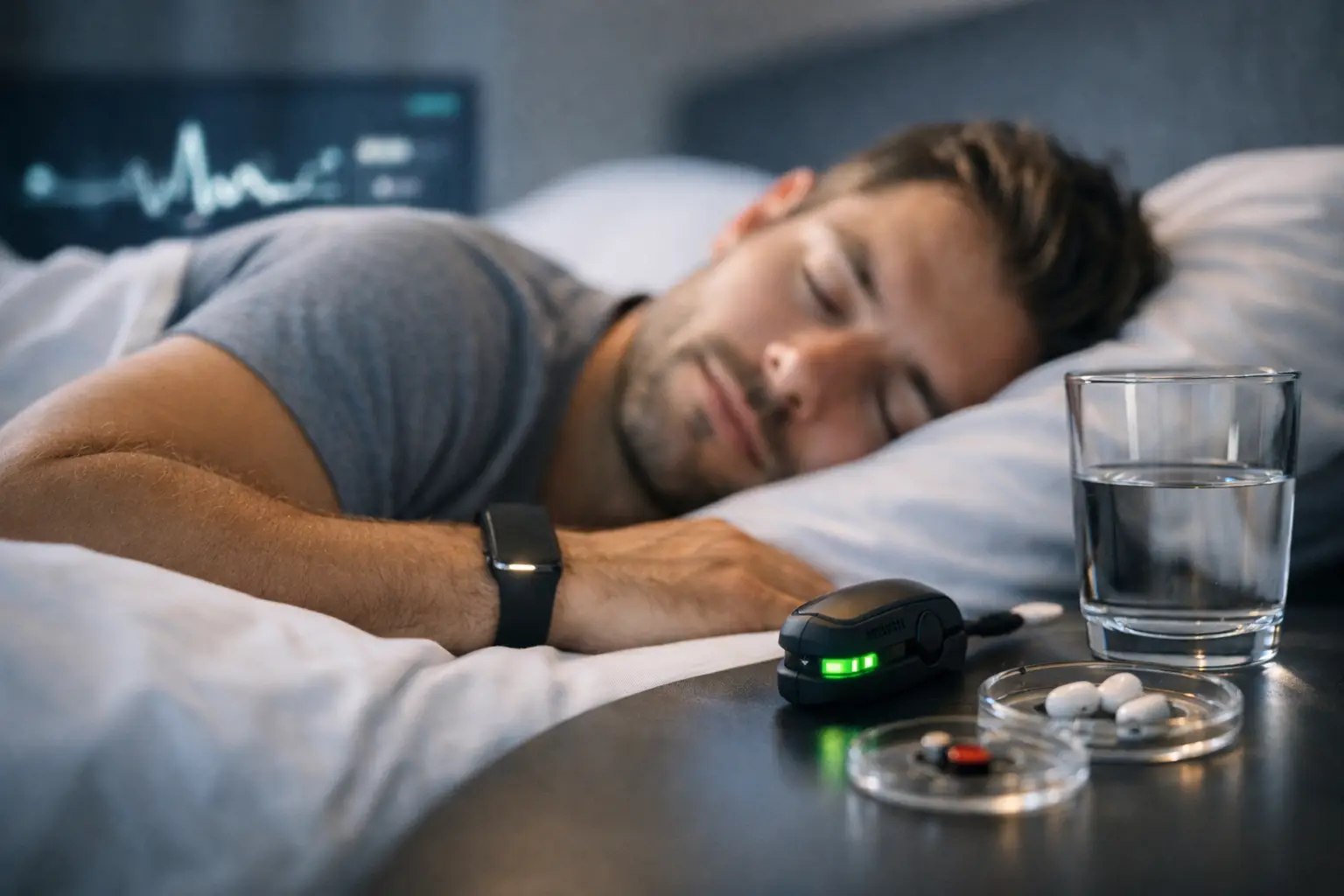
Your sleep quality is not measured by willpower or how early you go to bed. It is measured by what actually happens while you sleep. For high-performing athletes, busy professionals, and anyone managing training load or life stress, understanding which sleep biomarkers to track gives you reliable feedback about whether recovery is actually happening. That distinction matters because good intentions at bedtime and genuine recovery are not the same thing.
Most people focus on how many hours they slept. Hours matter, but they are only one dimension. Sleep architecture, autonomic nervous system balance, and the quality of different sleep stages paint a much more complete picture of whether your body is genuinely restoring itself or running on stored reserves.
Heart Rate Variability: The Recovery Mirror
Heart rate variability is one of the most useful biomarkers available through consumer wearables. Higher heart rate variability, particularly the root mean square of successive differences (RMSSD), is associated with better self-reported sleep quality, lower fatigue, and reduced stress, with these associations remaining significant even after adjusting for covariates.
Greater HRV during resting wakefulness is associated with better sleep efficiency measured over one-week periods in healthy individuals, with HRV functioning as an independent clinical biomarker of sleep quality. What makes this meaningful is the mechanism: high HRV reflects parasympathetic dominance, the "rest and digest" state. During deep recovery, this is what you want to see. Low or declining HRV often signals that your nervous system is stuck in a sympathetic state—the stress response. Training hard, emotional stress, inadequate recovery, and poor sleep all suppress HRV.
The value of tracking HRV is not in obsessing over daily fluctuations. It is in noticing patterns. If HRV drops when training increases, you know recovery is not keeping pace. If HRV improves after implementing sleep changes, you have objective confirmation that the changes are working. If HRV stays low despite adequate sleep, you may be dealing with overtraining, chronic stress, or another underlying issue.
Resting Heart Rate: The Stability Signal
A stable, low resting heart rate reflects a well-recovered nervous system. For most people, normal resting heart rate during sleep should be in the low 40s to mid-50s range, depending on age and fitness. Rates consistently above 60 during sleep signal that your body is not downregulating as it should. This can happen with inadequate sleep, high training load without sufficient recovery, caffeine use, sleep apnea, infections, or chronic stress.
Unlike HRV which varies day-to-day, resting heart rate is more stable. A sudden elevation or a gradual increase over weeks is a warning signal that warrants attention before it becomes an injury or illness.
Sleep Architecture: Deep Sleep and REM
Not all sleep hours are equally restorative. The structure of your sleep—specifically how much time you spend in different stages—directly affects recovery quality. Slow wave sleep amplitude increases initially during recovery sleep following sleep deprivation, then stabilizes during the remainder of the sleep episode, with minimal circadian control observed—demonstrating that sleep pressure and recovery need drive slow wave sleep dynamics.
Deep sleep (slow wave sleep or NREM 3) is where physical recovery occurs. During deep sleep, blood pressure drops, breathing stabilizes, muscles relax, and tissue growth and repair happen. A higher proportion of deep sleep naturally occurs in the first half of the night. Adults generally need 15-30% of their total sleep to be deep sleep, depending on age and activity level.
REM sleep is essential for emotional processing, memory consolidation, and cognitive recovery. You need adequate REM as well. When sleep is fragmented, light, or chronically insufficient, you get less of both deep and REM sleep, even if you spend the same hours in bed.
For athletes and people managing high physical load, inadequate deep sleep can slow recovery from training, increase injury risk, and suppress immune function. For high-stress professionals, insufficient REM sleep can impair learning, decision-making, and emotional regulation.
Sleep Efficiency: The Quality-to-Quantity Ratio
Sleep efficiency is the percentage of time you spend actually sleeping out of the total time in bed. If you are in bed for 8 hours but awake for an hour of that, your sleep efficiency is 87%. For most people, efficiency should be above 85%. Consistently lower efficiency signals fragmented sleep, early waking, or difficulty falling back asleep.
This metric exposes a common pattern: someone who is "trying" to sleep 8 hours but spending 9 in bed, with numerous micro-awakenings and broken continuity. Even with 8 hours attempted, they may only get 6.5 to 7 hours of actual consolidated sleep. The body knows the difference.
Heart Rate Variability Consistency: The Week-to-Week Pattern
More important than a single night's HRV is the consistency of HRV across nights. Large day-to-day swings in HRV suggest an unstable recovery picture. This can indicate inconsistent sleep schedules, variable training loads, stress spikes, or dietary factors. A steadier HRV trend, even if the absolute number is modest, suggests more reliable recovery.
Combining Metrics Into a Recovery Picture
A complete recovery profile uses multiple signals: HRV trends, resting heart rate stability, deep and REM sleep percentages, sleep efficiency, and total sleep duration. When these are tracked over weeks, patterns emerge that no single night reveals.
For example, someone might show good HRV and resting heart rate but poor sleep efficiency and low deep sleep percentage. This suggests nervous system recovery is happening, but sleep architecture is fragmented. The intervention might focus on sleep continuity and sleep hygiene rather than another meditation app.
Another person might have high deep sleep percentage but declining HRV and rising resting heart rate. This suggests sleep quantity is adequate but overall nervous system stress is accumulating. The issue is load, not sleep opportunity.
Actionable Sleep Optimization
Understanding your biomarkers is only useful when it changes how you train and recover. If wearable data shows declining HRV and elevated resting heart rate, the appropriate response is usually to reduce training volume or intensity, prioritize sleep further, or address an external stressor. It is not to train harder to "push through it."
If sleep efficiency is low but total sleep seems adequate, focus on sleep consolidation: consistent bedtimes, darker bedrooms, cooler temperatures, and a wind-down routine before bed. If deep sleep is low, strength training and movement during the day can improve it. If REM sleep is short, prioritize the last 2-3 hours of sleep, when REM naturally predominates.
The most valuable use of biomarkers is using them to test small changes and measure whether they actually work for you. Does a consistent bedtime improve your HRV? Does reducing caffeine after 2 p.m. lower your resting heart rate? Does adding strength training increase deep sleep? Track it, adjust it, and build the recovery plan that fits your actual physiology and life.
Ready to Optimize Your Recovery?
Join Moncton's monthly membership for personalized sleep and recovery optimization. Get a 12-week precision program built around your wearable data, sleep biomarkers, and personalized clinical recovery paths.
Learn About Thrive Membership